Women's pelvic pain
A pain diary for pain the scan doesn't show
Endometriosis, interstitial cystitis, pelvic floor pain. Conditions where the imaging can look fine and the pain is real, where symptoms move with the month, and where "how bad, how often" is the question every appointment turns on. Flare records what you feel, more than once a day if the day calls for it, and turns the record into a report a gynecologist or urologist can read in a minute.
Get Flare free iPhone · no account · tracking is free
The National Institutes of Health is direct about endometriosis: the severity of the pain does not correspond with the number, location, or extent of lesions. Some people with a few small lesions have severe pain; others with large patches have little. Interstitial cystitis is described the same way, with symptoms that vary among people, come and go, and change over time. In both cases the scan is not the measure. Your own record is.
One reviewer put it plainly: she had dealt with endometriosis for over a year and tracked everything in the Notes app for months before Flare. What mattered was logging more than once a day, because her pain at 8 a.m. was not her pain at 9 p.m.
What Flare sets up
Choose this profile during setup and Flare starts you here: the first symptom on the timeline, the rest suggested. Everything can be renamed, removed, or added to.
- Symptoms
-
- Pelvic pain
- Bladder pain
- Fatigue
- Nausea
- Descriptions
-
- Aching
- Burning
- Throbbing
- Stabbing
- Pressure
- Shooting
- Activities
-
- Exercise
- Pelvic floor PT
- Heat therapy
- Sitting
- Milestones
-
- Diagnosis
- Surgery
- Pelvic procedure
- Pelvic floor PT
- Nerve block
- Medication change
On the timeline from day one Suggested, one tap away
A few days in
One person's version, three days into logging, with two things Trends found in their data. Columns can be named anything, so theirs read a little differently. The name and the data are examples.
Example · Lena Started pelvic floor PT in the spring and watches cramping against heat therapy.
18 of 26 rated days were flare days before this milestone, 5 of 22 after.
Your cramping ratings were lower on days with heat therapy.
Recent 30 days · dots mark the activity
Heat therapy · Cramping · same day · all time
Record it
Tap a cell, pick one of five named levels: none, bearable, mild, moderate, severe. Never a number. Add cramping or bloating as their own columns beside pelvic pain, so a day that is "fine except for the cramping" is recorded as exactly that.
Milestones sit on the timeline as a labelled line: a diagnosis, a laparoscopy, a new medication, the first day of a period. They split your history into before and after, which is the comparison a clinician is looking for.
Understand it
After a few weeks, Flare can say how often flares come, how long they run, and what your baseline looks like between them. With a period marked each month, the same view answers the question the cycle-tracking guide is built around: does this move with the month, or is something else driving it? Three cycles is the honest minimum before trusting the answer. Cycle tracking arrives in Flare 2.0; the period-start milestone is how to start collecting that history now, so the answer is ready when the lens is.
Activity impact compares your ratings on days with and without intercourse, sitting, heat, or anything you add. Course impact does the same for each medication. Both report what was logged, not whether something worked, and both stay quiet until there is enough data to say anything at all.
Bring it to care
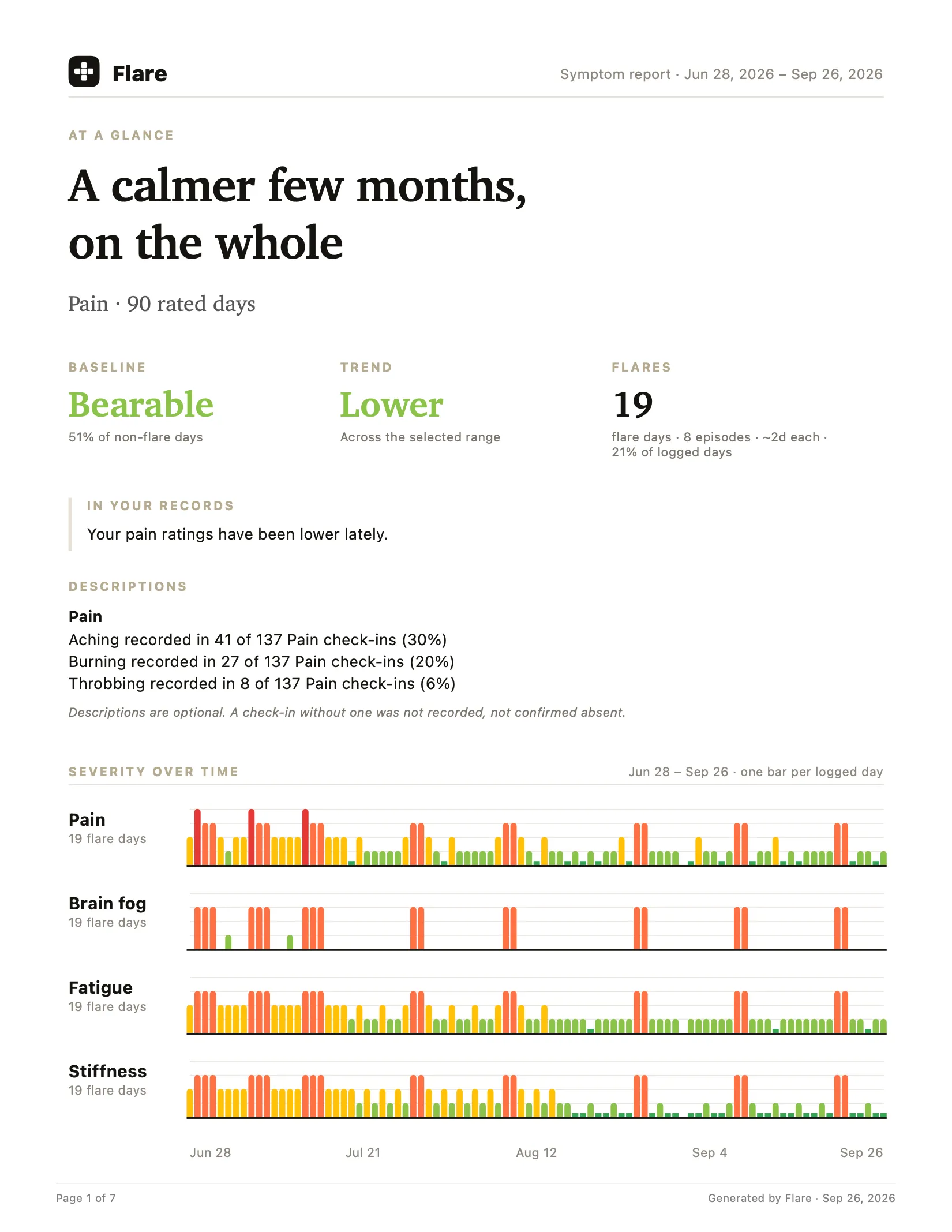
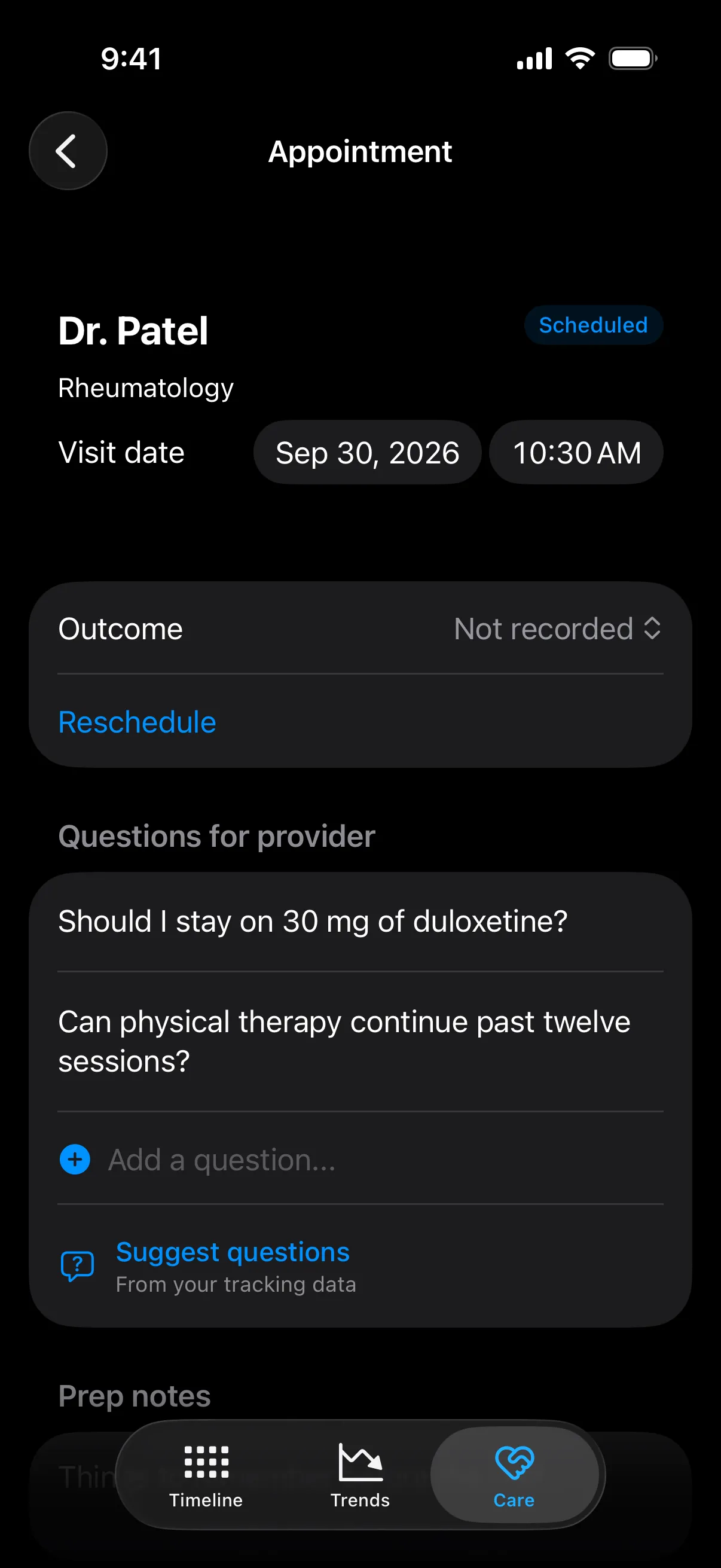
Add the appointment and Flare prepares a PDF covering the time since your last visit: a severity strip per symptom, medications and courses, activities, milestones, notes. It suggests questions drawn from your own log and keeps a record of what was said. Pelvic pain appointments are short and the history is long; the report is built for that gap.
No app yet, or a visit tomorrow? The appointment one-pager is a free printable that covers the same ground by hand.
Screens are Flare 2.1 with one example tracker’s data, the same one the homepage follows.
For years I thought everybody’s periods hurt like this. I thought I was just bad at handling pain. Endometriosis gave it a name, but it didn’t make it easier.
Sarah Howard, in the stories collected for Pain Awareness Month
Private by design
Flare has no account and no server. Symptoms, notes, medications, and visits stay on your iPhone. You decide whether to keep a backup in your own iCloud Drive, whether to export a PDF or CSV, and whether to turn on weather or sleep insights. The App Store privacy label reads "Data Not Linked to You", and the privacy policy says the same thing in more words.
Get Flare free Free tracking · Pro for trends and reports
Questions
- Does Flare track my cycle?
- Not as a built-in calendar. What works today: mark the first day of each period as a milestone on the timeline, and the phase of every other entry can be read off it later. Three or more cycles of ordinary logging with that one anchor is enough to see whether your symptoms move with your cycle. Cycle tracking is coming in Flare 2.0; until then the milestone does the job.
- Is Flare for endometriosis, interstitial cystitis, or pelvic floor pain?
- All three share the profile. It suggests pelvic pain, bladder pain, fatigue, and nausea, with words like aching, burning, and pressure for how a rating feels, and exercise, pelvic floor PT, heat therapy, and sitting as activities. Add cramping, bloating, intercourse, or anything else in a tap, and rename what does not fit.
- Can I log more than once a day?
- Yes, and for pelvic pain you probably should. Every entry is timestamped to the minute, so 8 a.m. cramping and 9 p.m. pressure are two rows, not one averaged number. Log when it adds context, skip when it does not. A day you skip stays a gap, unless you set a baseline for a symptom; then Flare fills it in, marked as baseline so it never passes for a rating you made.
- What does the report show a gynecologist or urologist?
- A severity timeline per symptom over the date range you choose, medications with dose changes and courses, activities, milestones, and your notes, formatted for a short appointment. Flare also keeps a record of each visit and suggests questions from your own log.
- Who can see what I log?
- Nobody but you. There is no account and no server. Symptoms, notes, and visits stay on your iPhone. You choose whether to keep a backup in your own iCloud Drive, whether to export a PDF or CSV, and whether to turn on weather or sleep insights.
- Is it free?
- Tracking is free with no trial clock. Flare Pro adds trend analysis, activity and course impact, visit snapshots, and PDF and CSV export, as a monthly or annual subscription with a free trial, or a one-time lifetime purchase.
Read next
Sources
- What are the symptoms of endometriosis? NICHD, National Institutes of Health
- Interstitial Cystitis (Bladder Pain Syndrome) NIDDK, National Institutes of Health
Flare - Chronic Pain Tracker is a symptom-tracking tool, not a medical device. Nothing on this page is medical advice. Endometriosis, interstitial cystitis, and pelvic floor conditions are diagnosed by a clinician; a log helps that conversation, it does not replace it.