Back pain
A back pain diary for pain that comes and goes
Chronic low back pain, sciatica, a disc that flares. Pain that shifts with how you sat, what you lifted, and how you slept, and that is hard to sum up in a ten-minute appointment. Flare records it in your own words, with sitting, lifting, and walking beside it, and turns the months into a report a doctor or physical therapist can read in a minute.
Get Flare free iPhone · no account · tracking is free
Back pain is one of the most common medical problems in the United States, according to the National Institutes of Health, which sorts it by how long it lasts: acute for a few days to a few weeks, subacute for 4 to 12 weeks, and chronic when it lasts longer than 12 weeks. Its list of symptoms reads like a tracking brief: pain that increases with lifting and bending, gets worse when sitting or standing, comes and goes, stiffness in the morning, pain that radiates into the buttocks, leg, or hip, and numbness or tingling.
When it travels down a leg, it is often sciatica. The National Health Service (NHS) describes it as pain, tingling, numbness, or weakness down the back of one leg that usually gets better in a few weeks to a few months, but can last longer. That is why leg pain gets its own column: a flare in the leg and a flare in the back are different entries, and the difference matters to whoever examines you. The NHS also lists the signs that need emergency care, not a log: sciatica in both legs, numbness around the genitals or bottom, or losing control of your bladder or bowels.
The coming and going is the hard part to explain. Which days followed a long drive or a day of lifting, how long a flare usually lasts, whether physical therapy changed anything: a log answers those, and memory in the exam room mostly says "it's been bad." If you swing between doing everything on a good day and paying for it after, the boom-bust cycle shows how to use a log to find your ceiling.
What Flare sets up
Choose this profile during setup and Flare starts you here: the first symptom on the timeline, the rest suggested. Everything can be renamed, removed, or added to.
- Symptoms
-
- Back pain
- Leg pain
- Stiffness
- Numbness
- Descriptions
-
- Aching
- Burning
- Throbbing
- Stabbing
- Pressure
- Shooting
- Tingling
- Pins and needles
- Activities
-
- Walking
- Exercise
- Stretching
- PT / physio
- Sitting
- Lifting
- Milestones
-
- Herniated disc
- Epidural injection
- PT started
- Surgery
- Injury
- Diagnosis
- Medication change
On the timeline from day one Suggested, one tap away
A few days in
One person's version, three days into logging, with two things Trends found in their data. Columns can be named anything, so theirs read a little differently. The name and the data are examples.
Example · Dev Logs every symptom, a muscle relaxant, and the days with lifting or walking.
Your back pain ratings were higher on days with lifting.
Recent 30 days · dots mark the activity
Lifting · Back pain · same day · all time
Recorded back pain ratings averaged highest in the evening on comparable days.
Back pain · recent 90 days
Record it
Tap a cell, pick one of five named levels: none, bearable, mild, moderate, severe. Never a number. Leg pain and numbness sit in their own columns beside back pain, so a bad day in the leg doesn't blur into a bad day in the back, and words like shooting or pins and needles say how it felt.
Log walking, stretching, a physio session, a long day of sitting, or lifting in the columns beside it; each is one tap. On a bad day the entry takes seconds, and a missed week can be backfilled whenever you get to it.
Understand it
With Flare Pro, Trends compares your own days. Activity impact looks at your ratings on days with lifting or sitting against the days without, on the same day and the two days after, because a back often sends the bill late. Time of day shows whether mornings or evenings are worse.
Milestones compare the four weeks before and after a moment you mark, like starting physical therapy or an epidural injection, and medication courses do the same for a muscle relaxant or a nerve pain medication. Everything is stated as what was logged, not what works, and nothing is said until there is enough data. A pattern is a lead to bring to your doctor or physio, not a verdict.
Bring it to care
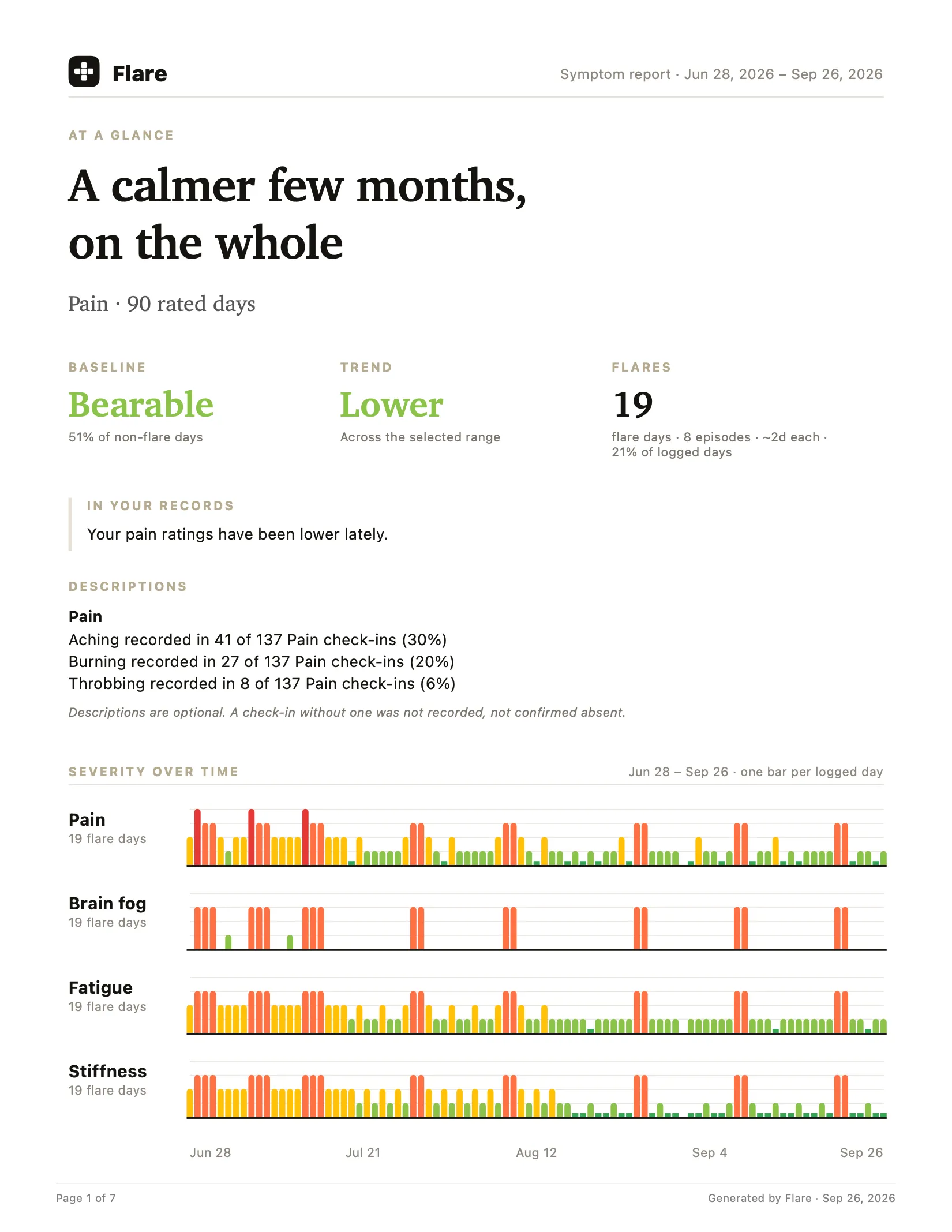
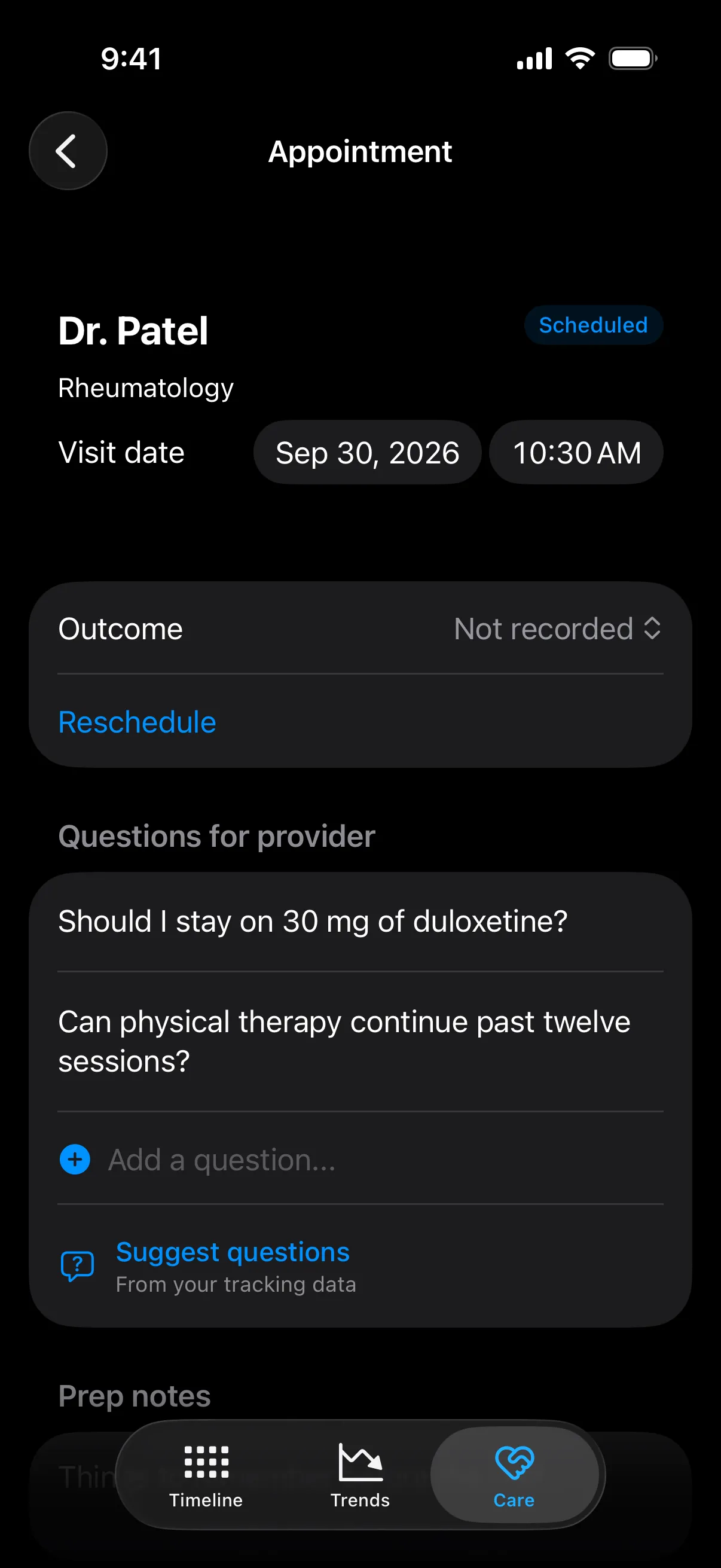
Add the appointment and Flare Pro prepares a PDF covering the time since your last visit: severity over time, flares, medications and courses, activities, and notes. It can suggest questions from your own log, and Flare keeps a record of what was discussed and what happens next. A family doctor, a spine specialist, or a physical therapist can read it in a minute.
No app yet, or a visit tomorrow? The appointment one-pager is a free printable that covers the same ground by hand.
Screens are Flare 2.1 with one example tracker’s data, the same one the homepage follows.
After a few weeks, I noticed that some of my worst days happened after I’d been sitting at work for long stretches.
Carl S., in the stories collected for Pain Awareness Month
Private by design
Flare has no account and no server. Symptoms, notes, medications, and visits stay on your iPhone. You decide whether to keep a backup in your own iCloud Drive, whether to export a PDF or CSV, and whether to turn on weather or sleep insights. The App Store privacy label reads "Data Not Linked to You", and the privacy policy says the same thing in more words.
Get Flare free Free tracking · Pro for trends and reports
Questions
- Is Flare made for back pain?
- Back pain is one of the seven profiles Flare offers during setup, and the one people choose most. It puts back pain on your timeline and suggests leg pain, stiffness, and numbness, with walking, stretching, physio, sitting, and lifting as activities. Everything can be renamed or removed.
- Can I track sciatica separately from my back pain?
- Yes. Leg pain and numbness are their own columns next to back pain, and you can rename them, for example to "Left leg" or "Sciatica". Words like shooting, burning, or pins and needles can go on any rating, so you can see whether the leg flares with the back or on its own.
- Can Flare show whether sitting or lifting makes it worse?
- With Flare Pro, activity impact compares your ratings on days with an activity against days without it, on the same day and in the two days after. It says what was logged, not what caused what, and it stays quiet until there is enough data to say anything.
- Do I have to log every day?
- No. Log when it adds context; backdating is normal and never flagged. If you'd rather not leave gaps, set the level a symptom usually sits at and Flare fills the days you don't log with it, marked as baseline so it never passes for a rating you made. Or leave it blank, and a gap stays a gap.
- Can I bring it to my doctor or physical therapist?
- Yes. Flare Pro makes a PDF for the dates you choose: a summary of the period, severity over time, flares, medications and courses, activities, and notes. Mark milestones like starting physical therapy or an epidural injection, and the report shows what came before and after.
- Who can see what I log?
- Nobody but you. There is no account and no server. Symptoms, notes, and visits stay on your iPhone. You choose whether to keep a backup in your own iCloud Drive, whether to export a PDF or CSV, and whether to turn on weather or sleep insights.
- Is it free?
- Tracking is free with no trial clock. Flare Pro adds trend analysis, activity and course impact, visit snapshots, and PDF and CSV export, as a monthly or annual subscription with a free trial, or a one-time lifetime purchase.
Read next
- The boom-bust cycle in chronic pain: using your log to learn your activity ceiling
- How to identify your flare triggers: a practical method
- How to describe pain to your doctor, so the ten minutes count
- Sleep belongs in the conversation: describing bad nights alongside your symptoms
- What counts as a flare? Defining your baseline and your flares
Sources
- Back Pain Symptoms, Types, & Causes National Institute of Arthritis and Musculoskeletal and Skin Diseases, National Institutes of Health
- Sciatica NHS
Flare - Chronic Pain Tracker is a symptom-tracking tool, not a medical device. Nothing on this page is medical advice. Back pain and sciatica are diagnosed and treated by a clinician; a log helps that conversation, it does not replace it.