Men's pelvic pain
A pain diary that started as one man's proof
Post-vasectomy pain, orchialgia, chronic prostatitis, pelvic floor pain. Conditions that are hard to point to, harder to describe, and often waved away. Flare records what you feel in your own words, shows you the shape of it over weeks, and turns it into a report a urologist can read in a minute.
Get Flare free iPhone · no account · tracking is free
In pain after a vasectomy right now? Post-vasectomy pain, mapped covers what normal healing looks like, the warning signs, how post-vasectomy pain syndrome is diagnosed, and every treatment side by side, with what the research says about each. Three questions get you a plan you can print for your next appointment.
Flare's designer, Andre, had a vasectomy that left a jolt of pain which never fully subsided. Three weeks later a doctor told him it was all in his head. So he opened a spreadsheet and logged his pain three times a day, every day, for a year. When he finally sat across from a urologist who read it, the pattern on the page helped make the diagnosis. That story is here, in full. The app is that spreadsheet, rebuilt for anyone who has been told the same thing.
Post-vasectomy pain syndrome is a recognised condition in the urology literature, defined as scrotal pain persisting more than three months after the procedure and severe enough to disrupt daily life. Chronic prostatitis and chronic pelvic pain syndrome are described the same way by the National Institutes of Health: pain that may come and go, appear suddenly or gradually. That coming and going is exactly what a log captures and a ten-minute appointment cannot.
What Flare sets up
Choose this profile during setup and Flare starts you here: the first symptom on the timeline, the rest suggested. Everything can be renamed, removed, or added to.
- Symptoms
-
- Pelvic pain
- Testicular pain
- Fatigue
- Descriptions
-
- Aching
- Burning
- Throbbing
- Stabbing
- Pressure
- Shooting
- Activities
-
- Exercise
- Ejaculation
- Pelvic floor PT
- Sitting
- Milestones
-
- Vasectomy
- Reversal
- Surgery
- Cord block
- Nerve block
- Diagnosis
- Medication change
On the timeline from day one Suggested, one tap away
A few days in
One person's version, three days into logging, with two things Trends found in their data. Columns can be named anything, so theirs read a little differently. The name and the data are examples.
Example · Sam Follows a Gabapentin course and how sitting and cycling line up with the pain.
Pain was logged lower during your Gabapentin course.
Gabapentin · Pain
Your pain ratings were higher on days with long sitting.
Recent 30 days · dots mark the activity
Sitting · Pain · same day · all time
Record it
Tap a cell, pick one of five named levels: none, bearable, mild, moderate, severe. Never a number. Log a pelvic floor PT session or a bike ride in the column beside it. On a bad day the whole entry takes seconds, and on a bad week you can backfill without being scolded for the gap.
Pain that is hard to describe as pain still fits. Aching, burning, pressure, and shooting are words you can add to any rating, so "a sickening feeling deep on the left side" has somewhere to go besides a note.
Understand it
The question nobody can answer in the middle of a flare is how long it usually lasts. After a few weeks of logging, Flare can: how often flares come, how long they run, what your baseline looks like between them. Andre's own data said two days, maybe three. On the nights it felt permanent, that number was the thing to hold.
Medication courses show your ratings before, during, and after each one. Activity impact does the same for ejaculation, cycling, sitting, or anything you add. Both say what was logged, not whether something worked, and both stay quiet until there is enough data to say anything at all. A pattern is a lead to bring to your doctor, not a verdict.
Bring it to care
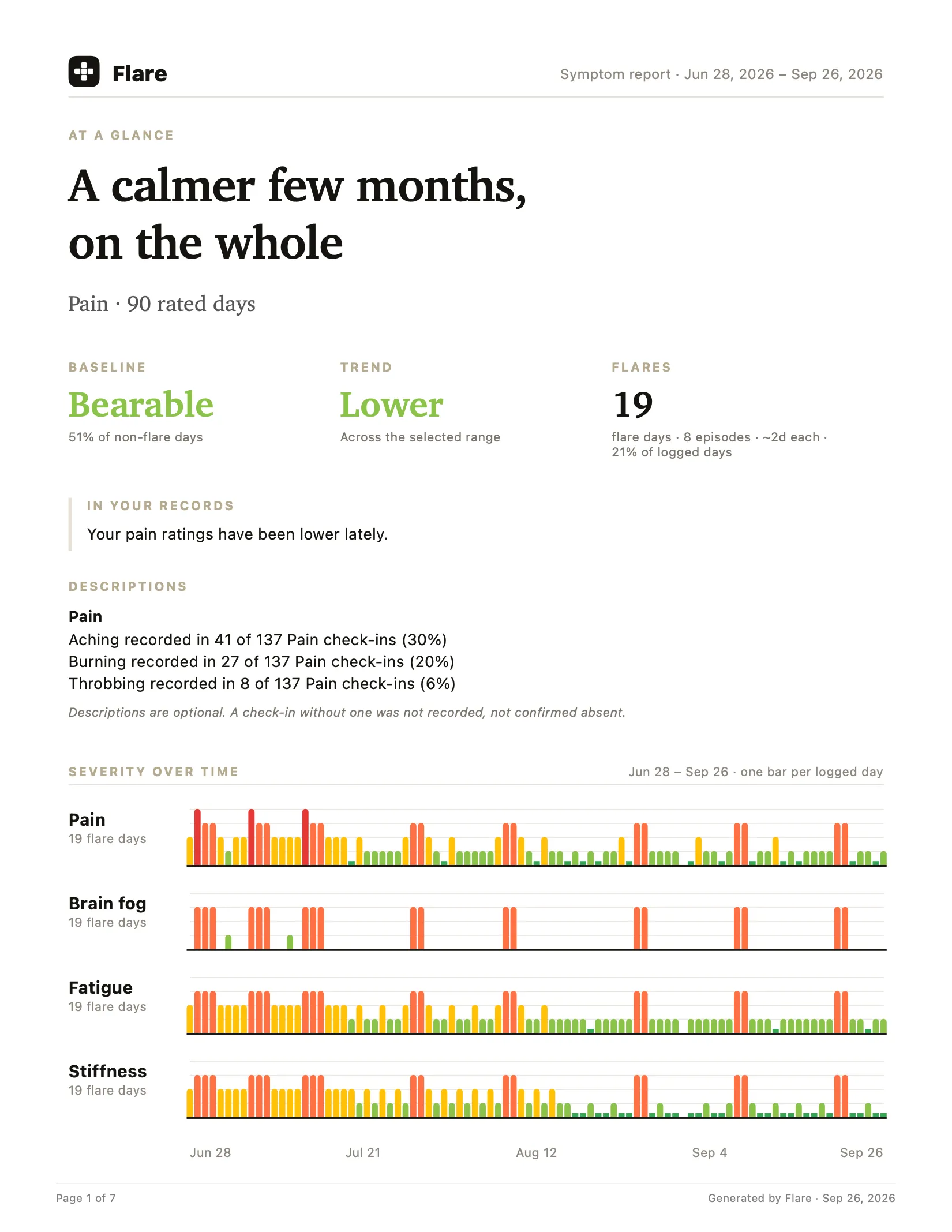
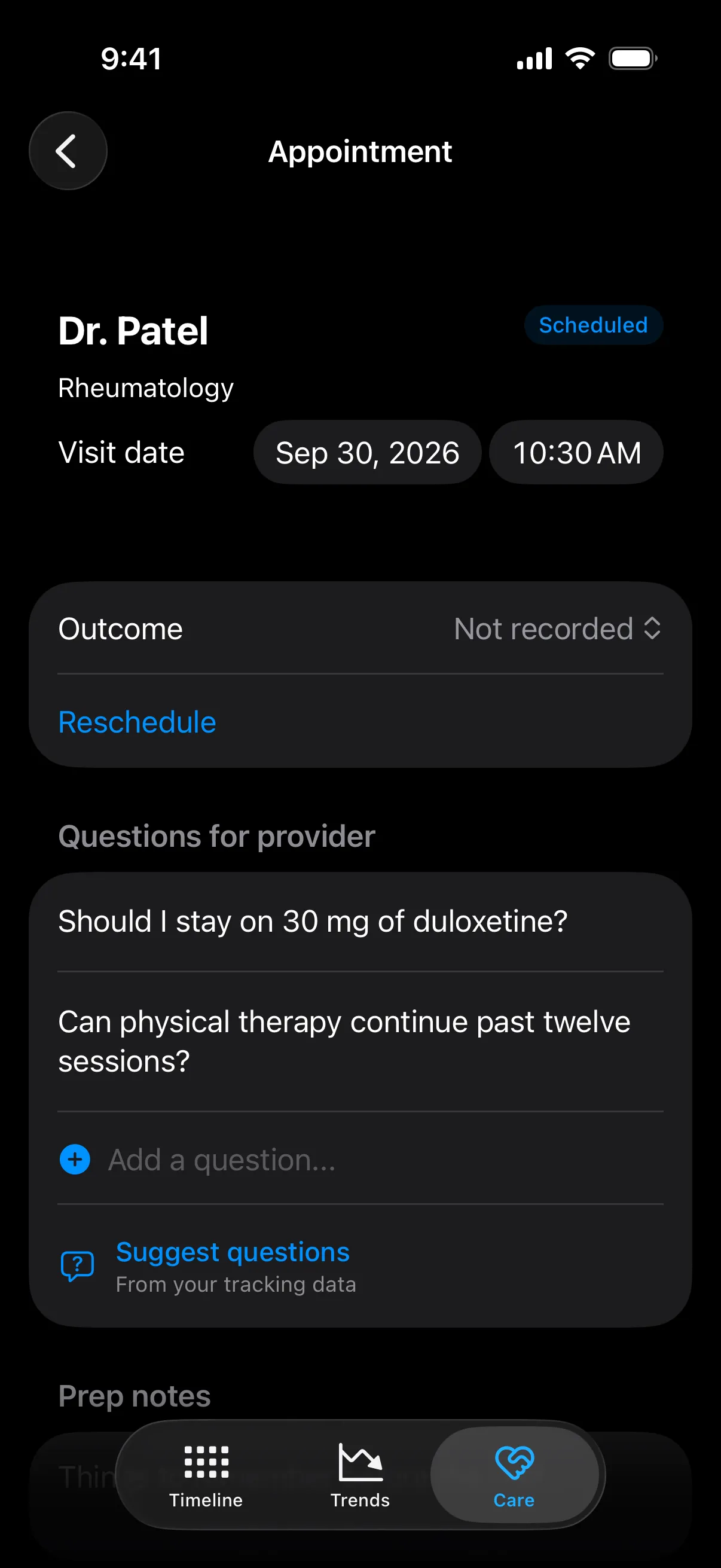
Add the appointment and Flare prepares a PDF covering the time since your last visit: severity timeline, medications and courses, activities, notes. It suggests questions drawn from your own log, and keeps a record of what was discussed and what happens next. The report is built for a urologist with ten minutes. That is the whole point of six months of two-minute entries.
No app yet, or a visit tomorrow? The appointment one-pager is a free printable that covers the same ground by hand.
Screens are Flare 2.1 with one example tracker’s data, the same one the homepage follows.
Private by design
Flare has no account and no server. Symptoms, notes, medications, and visits stay on your iPhone. You decide whether to keep a backup in your own iCloud Drive, whether to export a PDF or CSV, and whether to turn on weather or sleep insights. The App Store privacy label reads "Data Not Linked to You", and the privacy policy says the same thing in more words.
Get Flare free Free tracking · Pro for trends and reports
Questions
- Is Flare made for post-vasectomy pain?
- It was born from it. Flare's designer tracked his own post-vasectomy pain three times a day for a year before a urologist read the log and diagnosed him. The men's pelvic pain profile starts from that year: pelvic and testicular pain, the words for how it feels, and ejaculation and sitting as activities. Everything in it can be renamed or removed.
- Can I track ejaculation, cycling, or sitting as triggers?
- Yes. Ejaculation and sitting are suggested when you choose this profile, alongside exercise and pelvic floor PT, and cycling is one tap to add. Each gets its own timeline column, and Trends Pro compares your ratings on days with and without each activity once there is enough logged to say something.
- Do I have to log every day?
- No. Log when it adds context; backdating is normal and never flagged. If you'd rather not leave gaps, set the level a symptom usually sits at and Flare fills the days you don't log with it, marked as baseline so it never passes for a rating you made. Or leave it blank, and a gap stays a gap.
- Will my urologist actually read it?
- The PDF is built for a short appointment: a severity timeline, medications and courses, activities, and notes, over a date range you choose. One reviewer brought it to an appointment and was told the doctor wished more patients tracked like this. Flare also keeps a visit record and suggests questions from your own data.
- Who can see what I log?
- Nobody but you. There is no account and no server. Symptoms, notes, and visits stay on your iPhone. You choose whether to keep a backup in your own iCloud Drive, whether to export a PDF or CSV, and whether to turn on weather or sleep insights.
- Is it free?
- Tracking is free with no trial clock. Flare Pro adds trend analysis, activity and course impact, visit snapshots, and PDF and CSV export, as a monthly or annual subscription with a free trial, or a one-time lifetime purchase.
Read next
- Post-vasectomy pain, mapped: what is normal, when to worry, and every option
- "It's all in your head": my post-vasectomy pain story
- How to describe pain to your doctor, so the ten minutes count
- How to identify your flare triggers: a practical method
- What counts as a flare? Defining your baseline and your flares
Sources
- Post-vasectomy Pain Syndrome: A Review of the Literature and Updated Treatment Algorithm Cureus, via PubMed Central
- Prostatitis: Inflammation of the Prostate NIDDK, National Institutes of Health
Flare - Chronic Pain Tracker is a symptom-tracking tool, not a medical device. Nothing on this page is medical advice. Post-vasectomy pain syndrome, orchialgia, and chronic prostatitis / chronic pelvic pain syndrome are diagnosed by a clinician; a log helps that conversation, it does not replace it.