Tracking Fibromyalgia Flares: What to Record and What Patterns to Look For

Three short answers first, for anyone who searched mid-flare. A fibromyalgia flare is usually your everyday symptoms turned up: more pain, and often more fatigue, fog, and bad sleep with it. It can last days or it can last months. And the things people most often blame are stress, overdoing it, the weather, and poor sleep.
None of those answers is yours, though. Your flares have their own shape: how often they come, how long they stay, which symptom arrives first, and what tends to come before them. A log is how you find that shape, and this post is about what to put in it and what to look for.
What a flare looks like, according to the research
The National Institutes of Health describes fibromyalgia as a long-lasting disorder that causes pain and tenderness throughout the body, as well as fatigue and trouble sleeping, often with problems concentrating and remembering (fibro fog) and sensitivity to light, noise, odors, and temperature.
One of the few studies to follow flares as they happened asked people with fibromyalgia to keep a diary for six months and write down any clear worsening that lasted more than a day. Three findings are worth knowing before you start your own log:
- Flares were common. Three in four of the people who completed the diary had at least one in six months, with an average of two each.
- Flares were long. They averaged 11 weeks. That is not a bad weekend; it is most of a season.
- Flares were more than pain. Widespread pain, fatigue, brain fog, and sleep problems showed up in almost everyone during a flare.
It was a small study at one hospital in Madrid, with no comparison group, and an average hides a wide range. But it points at two things a fibromyalgia log has to handle that a simple pain diary doesn’t: several symptoms at once, and flares long enough to outlast your memory of how they started.
What to record
Keep it to what you’ll still manage on a bad week. Everything below takes seconds once it’s set up.
- Four symptoms, rated separately: widespread pain, fatigue, brain fog, and stiffness, each on the same few named levels (none, bearable, mild, moderate, severe) every time. Why named levels beat 0 to 10. A day with mild pain and severe fatigue is a different day from the reverse, and one combined number erases the difference.
- When you rate. Once a day at a consistent time is enough. If you can, rate fatigue in the morning too. The National Health Service (NHS) notes that you may often wake up tired, even after plenty of sleep, and morning fatigue is worth seeing on its own.
- What you did. Exercise, a nap, heat or ice, and the one people forget: a big day. Work deadline, travel, a family event, a long shop. Overexertion is one of the most-named triggers, and it is invisible in a log that only records symptoms.
- Sleep. Hours come from a wearable if you have one. How rested you felt only comes from you.
- What you take, with start and stop dates. Anything new, anything stopped, any dose change.
- The day a flare starts. Mark it, even roughly. With flares that can run for weeks, the start date is the anchor everything else is compared against.
Four patterns worth looking for
After a couple of months, stop reading your log day by day and start asking it questions.
1. What your flares look like. How often do they come, how long do they last, and how far above your usual level do they go? Write down your baseline first, because a flare only means something against it. If your flares run for weeks, look at them by the week and the month. Daily ups and downs inside a long flare are noise; the length of the flare is the signal.
2. Which symptom moves first. With four symptoms rated separately, you can see whether flares tend to start with worse sleep, more fatigue, or foggier days before the pain climbs. Nobody can tell you in advance whether you have a pattern like this. If you do, it’s the most useful thing a log can give you, because it’s an early warning.
3. What came before. Look back from the start of each flare, not just at the same day. The study’s list is a good set of suspects: ongoing stress, intense stress, physical overexertion, weather changes, and poor sleep. (The study’s authors point out that sleep problems can be both a trigger and a symptom, which is one more reason to record sleep and fatigue separately.) Each has its own timing. Stress often arrives with a lag, overexertion tends to send the bill a day or two later, and weather is worth testing rather than assuming. The general method is in how to identify your flare triggers.
4. Whether anything you changed moved it. A new medication, a new routine, a change in how you pace your days. Compare the weeks before and after, not the days, and give it long enough to be fair. With flares that can last longer than a month, a two-week trial can’t tell you much.
Whatever you find is a lead, not a verdict. A pattern in your own log is something to bring to your rheumatologist, and what it can and can’t tell you is worth reading before you act on it.
Keep it light enough to keep going
Fibromyalgia makes tracking harder than most conditions do. The same fatigue and fog you’re trying to record make recording feel like one more job. So set the floor low: on the worst days, one rating is enough. Gaps are fine. A log with gaps you kept for six months beats a perfect one you gave up on in week two.
What to bring to your rheumatologist
Not the log itself. A summary of it:
- How many flares in the last few months, and roughly how long each lasted.
- Which symptom was worst during them, and which one moved first if you saw a pattern.
- What you suspect came before them, framed as a question.
- What you changed, and what happened in the weeks after.
How to describe pain to your doctor turns that into a sentence that opens the appointment well, and preparing for the appointment covers what to ask.
Where Flare fits
Flare - Chronic Pain Tracker was built for exactly this kind of log. Its fibromyalgia profile starts with widespread pain on the timeline and suggests fatigue, brain fog, and stiffness, with words for each, and exercise, naps, heat, and ice as activities. You can mark a major flare onset as a milestone. Tracking is free.
Flare Pro adds Trends. At a glance shows your usual level, how often flares come, and how long they last. Connect Apple Health and each night’s sleep is paired with the next day’s ratings. Weather, activities, and medication courses get the same treatment, and the months become a PDF for the appointment.
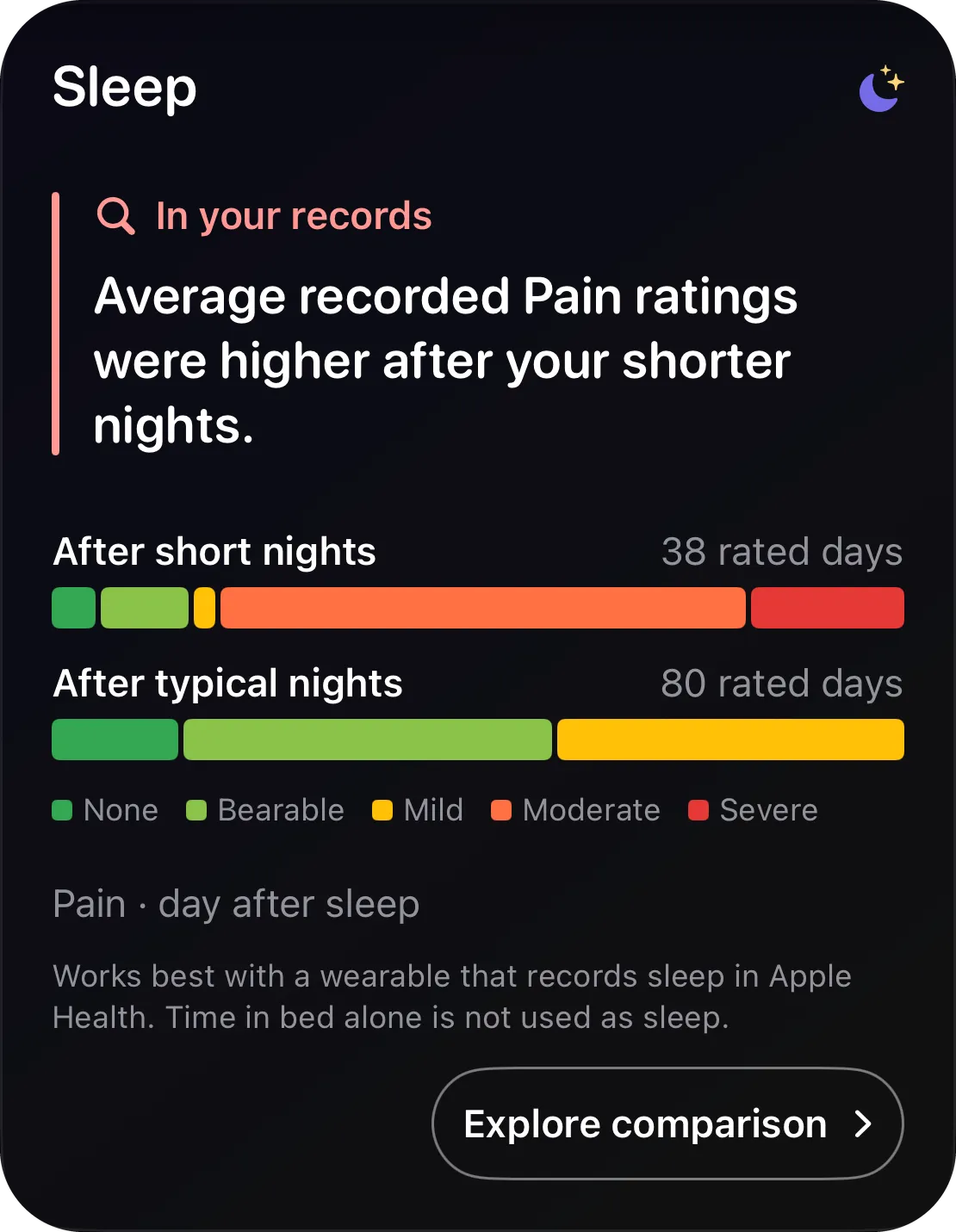
Flare’s Sleep card, shown with sample data.
None of it is required. A notebook or the free printable diary works too, as long as you rate the same symptoms the same way and keep going long enough to see a flare from start to finish.
Frequently asked questions
What does a fibromyalgia flare feel like?
Usually like the everyday symptoms, turned up: more widespread pain, and often more fatigue, trouble thinking clearly (fibro fog), and worse sleep at the same time. In a six-month diary study of people with fibromyalgia, pain, fatigue, brain fog, and sleep problems showed up during flares in almost everyone. What a flare feels like for you is best defined against your own usual days, which is what a log records.
How long does a fibromyalgia flare last?
It varies a lot. In one six-month diary study that only counted worsening lasting more than a day, flares averaged 11 weeks, and many people had more than one. Others have flares measured in days. Your own typical flare length is more useful than any average, and a few months of ratings on the same scale will show it.
What triggers fibromyalgia flares?
In the same diary study, people most often linked their flares to ongoing or intense stress, physical overexertion, changes in the weather, and poor sleep. The National Health Service (NHS) lists stress, weather, and how physically active you are. These are what people report, not proven causes, and they differ between people, so the honest way to find yours is to log them next to your symptoms and look at what came before your flares.
Is there an app that can track fibromyalgia symptoms?
Yes, several general symptom trackers can, and a notebook works too. What matters for fibromyalgia is being able to rate several symptoms separately (pain, fatigue, brain fog, stiffness) on the same scale every time, note activities and sleep beside them, and look back over months rather than days. Flare, the app this blog is written by, has a fibromyalgia starting profile that does this.
Sources
- Fibromyalgia Symptoms, Causes, & Risk Factors — National Institute of Arthritis and Musculoskeletal and Skin Diseases, National Institutes of Health
- Characterizing fibromyalgia flares: a prospective observational study — Reumatologia, accessed on PubMed Central
Flare - Chronic Pain Tracker is a symptom-tracking tool, not a medical device. This article is general information, not medical advice — talk to your doctor about decisions affecting your health.